When teachers in Singapore came back from the holidays in January 2026, the first message waiting for them was not another initiative to absorb. It was a promise to take some weight off.
On January 5, 2026, Education Minister Desmond Lee sent a video message to educators with a clear framing: the Ministry of Education wants to "recalibrate what teachers do and rethink how teachers work." Behind that phrase sits a concrete package, and a meaningful chunk of it runs on AI. For once, the technology story is not "here is one more thing to learn." It is "here is something meant to give you time back."
Let us walk through what actually changed, and what it means if you are the one standing in front of the class.
What Was Announced
The January package has a few moving parts, but three stand out for teachers.
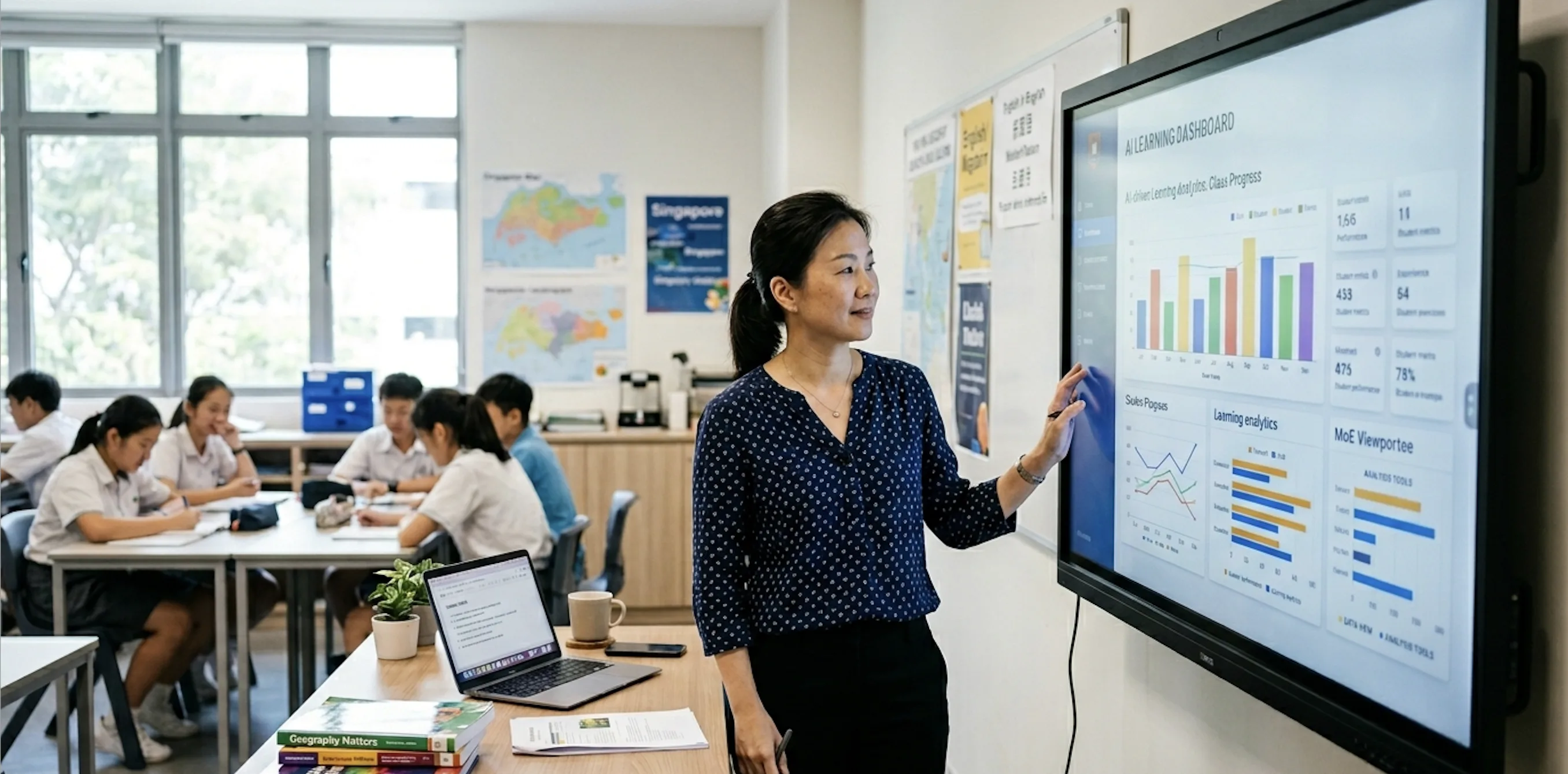
AI tools to cut repetitive work. MOE is rolling out an Authoring Copilot to help teachers create lesson and assessment materials, and a Learning Assistant platform to support teaching and learning. The point of both is the same: take the routine, time-eating tasks off a teacher's plate so the hours go to students instead.
Flexible work arrangements, reinforced. The package strengthens flexible and protected working time rather than treating "always on" as the default.
Clearer boundaries on after-hours contact. There are stricter guidelines on after-hours communication with parents, which sounds small but addresses one of the quieter sources of teacher fatigue.
None of this is framed as AI replacing the teacher. The opposite, in fact. The stated goal is to free up bandwidth so educators can focus on the meaningful, human parts of teaching that no tool does well.
Why This Matters Now
Here is the honest context. Singapore teachers are not, by the data, working wildly more hours than before. In the Committee of Supply debate in March 2026, MOE reported that teacher workload has stayed broadly stable over the years at an average of around 53 hours a week. What has changed is the complexity. As Lee put it, educators often go beyond their formal duties because they treat their students' growth as their own responsibility, and the worry is that this commitment quietly turns into an unsustainable load.
That is the real problem these tools are pointed at. Not raw hours on a spreadsheet, but the accumulation of small administrative tasks, the lesson prep that eats evenings, the messages that arrive after dinner. AI is being asked to clear the low-value work so the high-value work has room to breathe.
How This Fits Singapore's Bigger AI-in-Education Approach
This announcement does not stand alone. It sits inside Singapore's broader EdTech Masterplan 2030 and the MOE AI in Education (AIEd) Framework, which is built around four principles: Agency, Inclusivity, Fairness and Safety. The framework's whole posture is "pedagogy first, students at the centre, teacher judgment preserved." Teachers are meant to stay in control of how AI is used, not hand the wheel over to it.
You can see that philosophy in the tools already running in the Student Learning Space, like LEA, the AI feature that guides students with questions rather than handing them answers, and which a teacher has to activate. The design choices are deliberate: keep the teacher in the loop, avoid spoon-feeding, protect the thinking that school is supposed to develop. The workload tools are the same idea applied to the teacher's own day.
What It Means for Teachers, Practically
If you teach in Singapore, a few things are worth holding onto.
The tools are there to serve you, not to monitor or replace you. The framing all the way from the minister down is support, and the AIEd Framework explicitly preserves teacher agency. That is a healthier starting point than a lot of AI rollouts elsewhere.
Early familiarity pays off. As with any new tool, the teachers who spend a little time getting comfortable with the Authoring Copilot and Learning Assistant will get more out of them, sooner. You do not need to be a power user. You need enough fluency to trust the time savings.
Protect the time you get back. The risk with any efficiency gain is that it quietly gets filled with more tasks. The point of the package is bandwidth for students and for your own sustainability. Treat the reclaimed hours as the win they are meant to be.
The boundaries are part of the policy, not a personal failing. If after-hours parent messages have been creeping into your evenings, the new guidelines exist precisely to back you up. Leaning on them is using the policy as intended.
The Bigger Picture
Singapore is doing something quietly distinctive here. A lot of education systems are racing to put AI in front of students. Singapore is also pointing it at the teacher's own working life, with the explicit aim of making the profession more sustainable. That is a teacher-first instinct, and it is the right one.
The honest caveat is that announcements are not outcomes. Whether these tools actually lighten the load depends on how well they work in real classrooms, how much training teachers get, and whether the reclaimed time stays reclaimed. Those are the things worth watching over the coming year.
This is the work we care about at thegurucool: helping teachers build real, practical confidence with AI so the tools genuinely serve them rather than adding to the pile. If that is the kind of support you want as these changes land, join our teacher community and we will keep you in the loop.
The tools are arriving either way. The teachers who treat them as time given back, and protect that time, are the ones who will feel the difference.
Related reading: What Does Medicine Know About Professional Development That Teaching Still Hasn't Figured Out? · AI Is Now in Asian Classrooms. Are Teachers Actually Ready for It?