There is a quiet illusion at the heart of modern classrooms. Students complete tasks. They submit answers. They participate. They nod. And we leave the room with the comforting sense that learning has occurred.
But performance is not the same as intellectual movement.
The Difference Between Doing and Thinking
A student can reproduce information without revising a single belief. They can follow procedures without interrogating assumptions. They can score highly on a structured assessment while remaining cognitively unchanged.
Real learning is not exposure to content. It is the restructuring of thought. It is the moment a student realises that what they previously held to be obvious is now insufficient. That movement is subtle. But it is the only meaningful evidence that something has actually happened in a lesson.
Why This Matters Now More Than Ever
In an era where students have instant access to any information through AI, the value of a teacher cannot be the delivery of content. That job has been automated.
The irreplaceable role of the teacher is the ability to cause genuine cognitive disruption, to challenge what students assume they already know, to surface the gaps between what they believe and what is actually true.
The One Question That Changes Everything
Tomorrow, at the end of your lesson, instead of asking "Are there any questions?" try this:
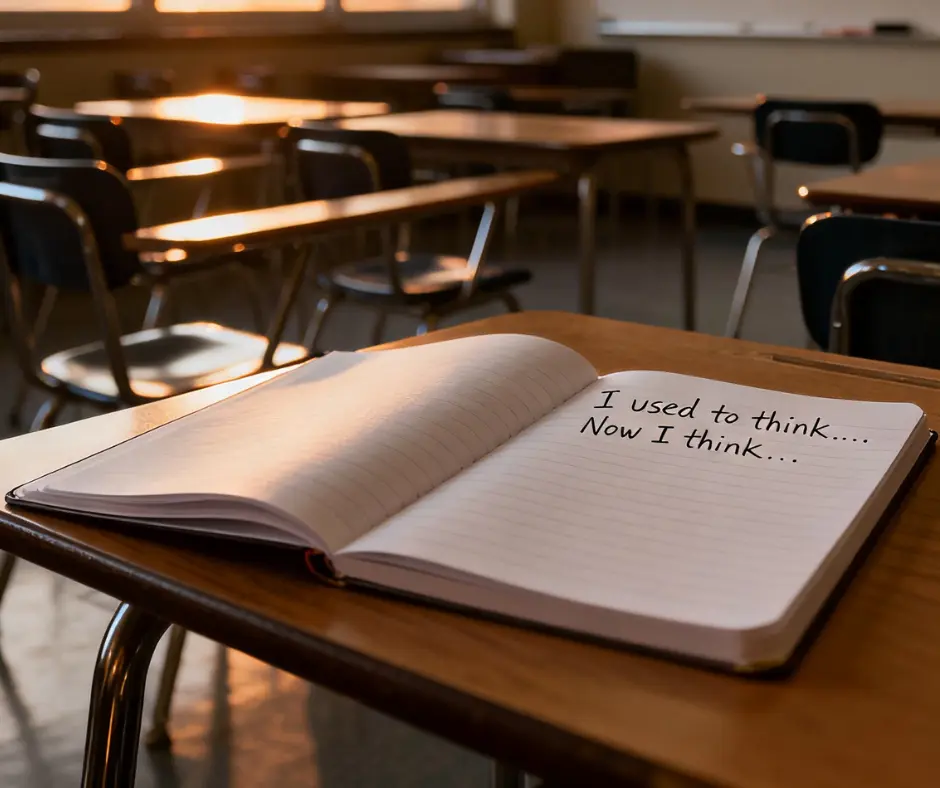
"What did you change your mind about today?"
Then wait. Give students two quiet minutes to write before anyone speaks. This question does three things: it makes thinking visible, it trains students in metacognition, and it gives you diagnostic precision as a teacher.
If no one changed their mind, you have not yet penetrated the surface of the topic. You may have informed your students. But you have not disrupted their prior understanding.
The Epistemological Challenge for Teachers
When was the last time your own professional learning caused a genuine shift in how you see teaching? Not a workshop you sat through and ticked off. A real revision of your practice.
The question "What did you change your mind about?" is not just a classroom strategy. It is a professional standard. It is how we measure whether growth has actually occurred, both in our students and in ourselves.
A Different Definition of Progress
The most radical move a teacher can make may not be technological. It may be epistemological. The decision to define learning not as activity, but as cognitive revision.
The classroom does not need more noise. It needs sharper questions. Ask it tomorrow. See what you find out.